营销
X Search Digest
Search X once through Xquik and return normalized posts, a readable digest, and pagination information.
下载工作流
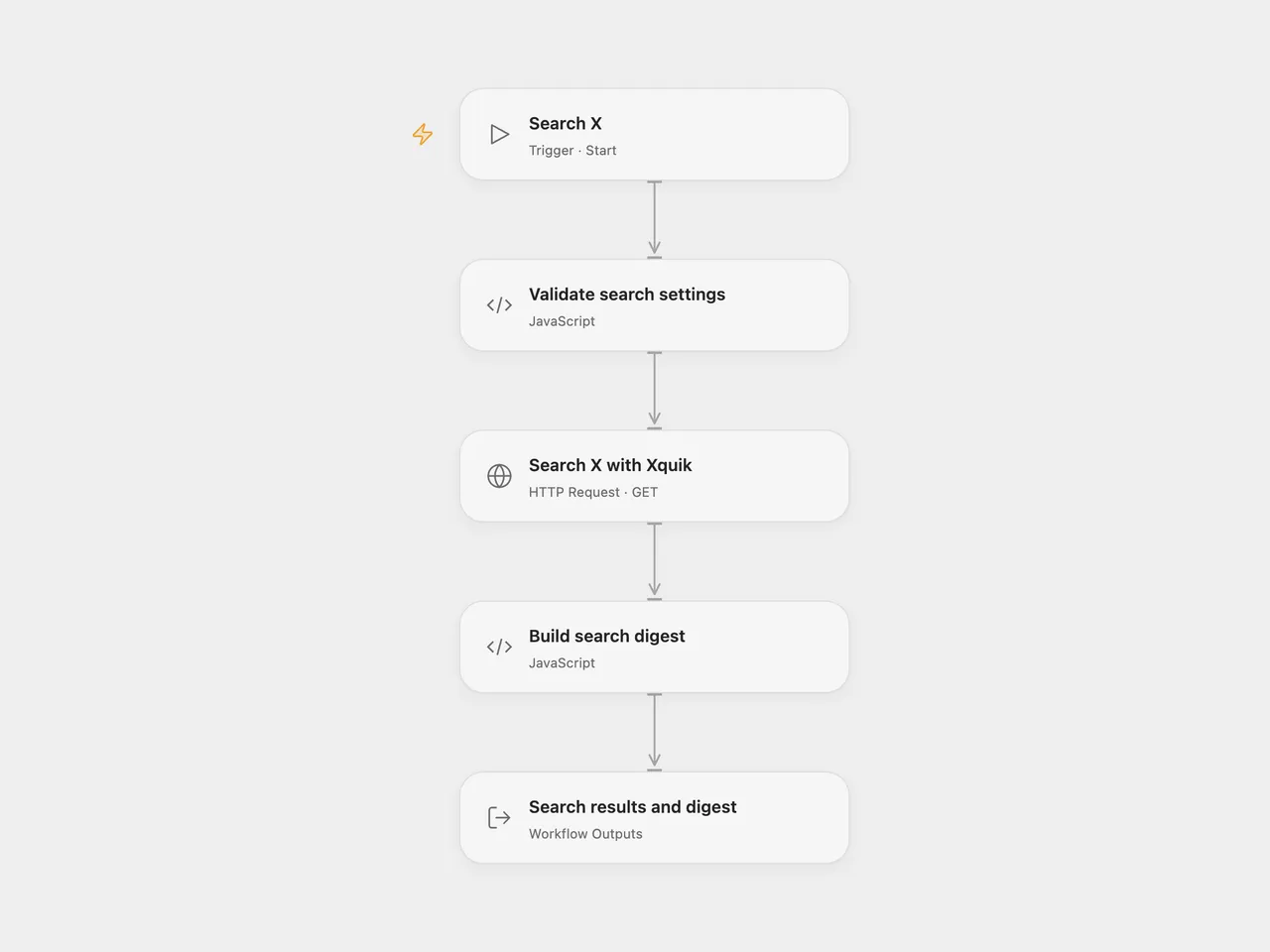
Run a query through Xquik and receive normalized X posts with a plain-text digest. The workflow reads one response and returns its pagination flag and cursor.
Setup
In Open Flow, import the JSON and bind Search X with Xquik → Authentication token to a secret Variable containing your Xquik API key. The template leaves this value empty. Enter query and limit when starting the workflow, for example n8n automation and 10.
In n8n, edit Search Settings. Create a Header Auth credential with name X-API-Key and your Xquik key as its value, then select it on Search X with Xquik. Run Manual Trigger.
Use a nonempty query of up to 4,096 characters and an integer limit from 1 to 10,000. Xquik recommends keeping queries within 512 characters; larger or expensive searches may fail or return fewer rows because of service limits or available quota. See the official API specification for current search behavior.
Results
tweetscontains each returned post’sid,url,text,author,created_at, andmetrics.digestnumbers posts in response order and separates them with blank lines. No matches returnsNo matching X posts found for this query.results_count,has_more, andnext_cursordescribe this response. The workflow does not follow the cursor or claim to retrieve every match.
Each run makes one search request, with a 120-second task/request timeout and no workflow retry. HTTP failures or malformed responses stop the run. A repeated run performs another search; there is no saved watermark, deduplication, posting, or model call.
Changes to the source
- Store the API key in the platform’s secret configuration instead of an environment expression.
- Validate the query and limit before searching, and reject malformed responses instead of reporting them as no matches.
- Read the current Xquik
has_next_page,createdAt, and metric fields while retaining the source’s older field aliases. - Use real line breaks in the digest.
Adapted from Monitor X Search with Xquik in enescingoz/awesome-n8n-templates.
Source collection notice: © 2024–2026 Enes Cingoz, CC BY 4.0. The source export does not identify a separate template author or license. This adaptation includes the changes listed above; see repository licensing for the scope of OOMOL contributions and third-party material.