內容
French to English Audio
Generate French speech from text, transcribe it, translate the transcript into English and generate English speech in the same voice.
下載工作流程
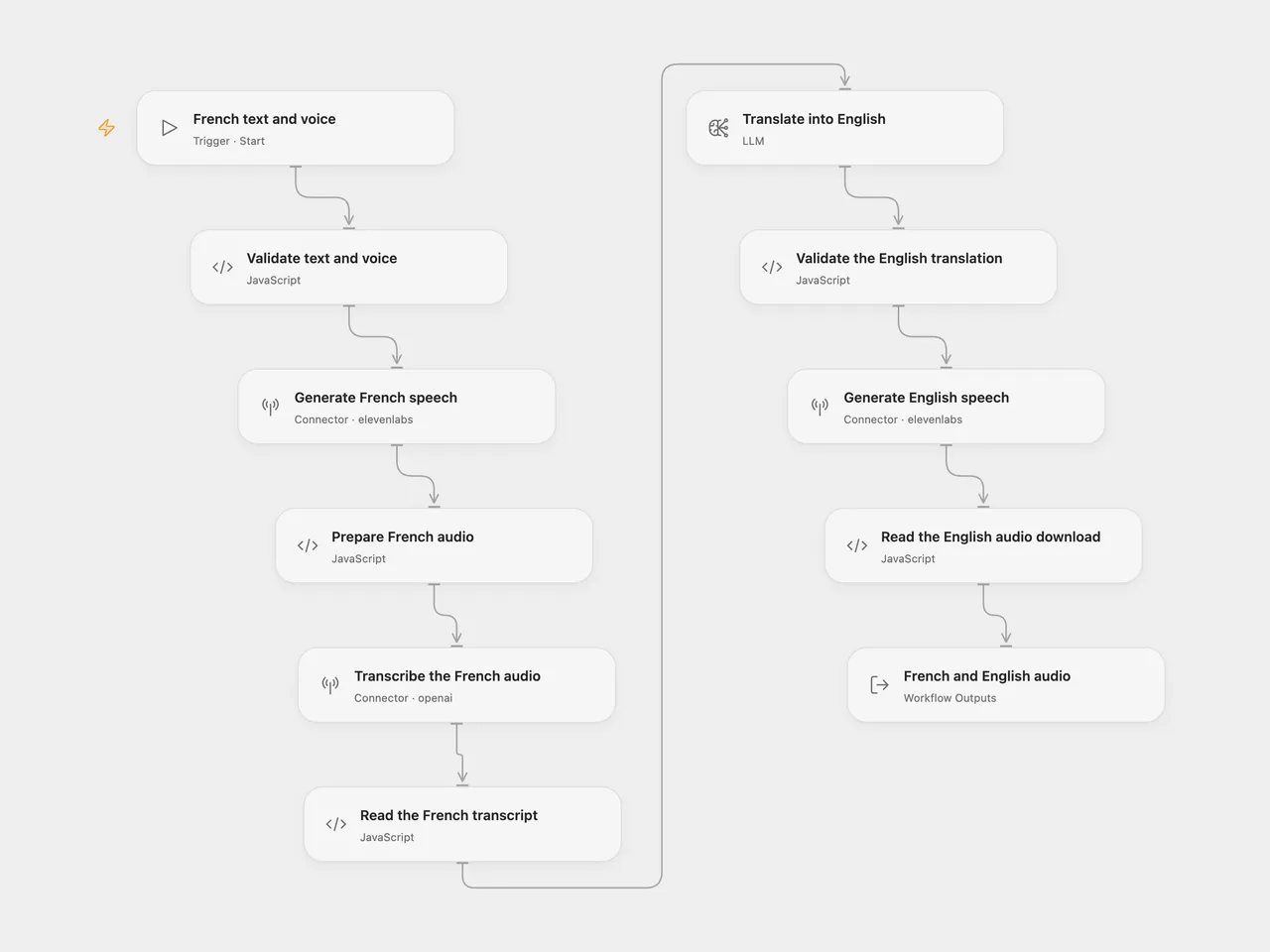
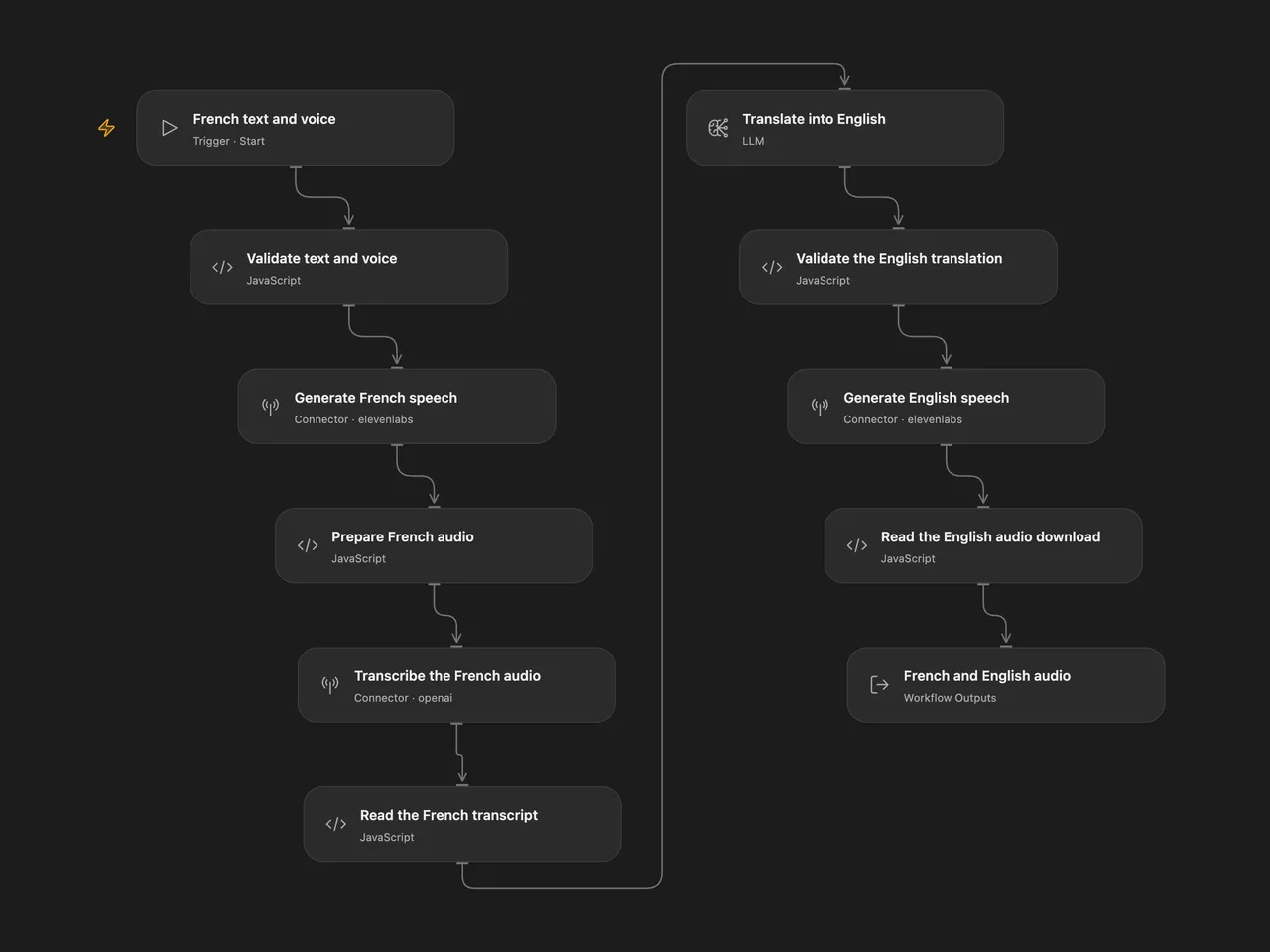
Turn French text into French speech, transcribe that audio, translate the transcript into English and synthesize the English text in the same ElevenLabs voice.
Setup and use
Use only text and audio that can be public. In Open Flow, both generated recordings are uploaded to Connector storage with public-read download URLs. Anyone with a URL can download that recording. Automatic expiry has not been verified; retention depends on the storage deployment. A later failure can leave the earlier French recording hosted. n8n keeps the recordings as execution binary files.
Connect ElevenLabs in Generate French speech and Generate English speech. Your voice must support French and English, with allowance for eleven_multilingual_v2. The Open Flow Connector deployment must have file transit enabled. Connect OpenAI in Transcribe the French audio, and select a configured gpt-4o-mini-2024-07-18 model in Translate into English.
Use Run and supply:
{
  "french_text": "Bonjour. Notre équipe prépare un guide public pour expliquer son travail.",
  "voice_id": "YOUR_ELEVENLABS_VOICE_ID"
}
Replace the voice ID with one available to your ElevenLabs account. French text must be nonempty and fit 10,000 characters. The original text is synthesized without trimming; the translated English text is trimmed and must also fit 10,000 characters. Both speech steps use the same voice, stability 0.5, similarity boost 0.5 and MP3 format mp3_44100_128. The source’s latency optimization level 1 is retained; ElevenLabs currently marks this option deprecated.
For n8n, edit Configure French Text and Voice. Select Header Auth credentials on both ElevenLabs HTTP nodes with header name xi-api-key and your API key as its value. Select OpenAI credentials in Transcribe Audio and English Translation Model. Use Execute Workflow. Keep keys in credentials.
Behavior
The workflow generates French audio, transcribes that generated recording with whisper-1, translates the transcript into English at temperature 0, and generates English audio in the same voice. It does not skip the French synthesis or transcription. Quotes and line breaks remain valid in both speech requests.
Open Flow returns frenchTranscript, englishText, frenchAudio and englishAudio. Each audio object contains name, mimetype and its public download url. Download the files you need while your storage deployment retains them. n8n returns the transcript and translation with English audio in binary data and French audio in binary french.
Two speech generations, one transcription and one translation step consume the selected services’ allowances. No workflow-level retries are configured. n8n’s model adapter can retry transient translation requests internally; a configured model service may have its own request behavior. A failed speech, transcription or translation step stops later work. There is no rollback of generated or hosted audio. Service request limits still apply; Whisper accepts files up to 25 MB, and long text can reach generation or transfer limits. The workflow checks returned file references and audio MIME types; it does not verify speech or translation accuracy. Review the text and listen before sharing a recording, and disclose that its voice is AI-generated.
OpenAI has announced shutdown of the default translator snapshot on January 14, 2027 and whisper-1 on February 26, 2027. Configure compatible replacements in both formats before those dates and verify their request and response formats. This template retains the source transcription endpoint; it uses a separate text translation step.
Changes to the source
- Make French text and voice ID reusable inputs, with a neutral example in n8n.
- Build speech requests as JSON objects so quotes, newlines and Unicode remain valid.
- Replace the source’s omitted translator choice with the explicit snapshot above, which supports its configured temperature. The source currently imports with n8n’s
gpt-5-minidefault; this model change can change translation wording. - Validate empty transcripts and translations before later generation, and make MP3 output explicit.
- Return both recordings and the intermediate texts. Open Flow uses public-read hosted downloads instead of n8n execution binary storage; only use material that can be public, with no verified automatic expiry.
Adapted from Translate audio using AI in enescingoz/awesome-n8n-templates.
Source collection notice: © 2024–2026 Enes Cingoz, CC BY 4.0. The source export does not identify a separate template author or license. See repository licensing for the scope of OOMOL contributions and third-party material.