Data
Log ISS Position to BigQuery
Record the current International Space Station position in a BigQuery table each minute.
下載工作流程
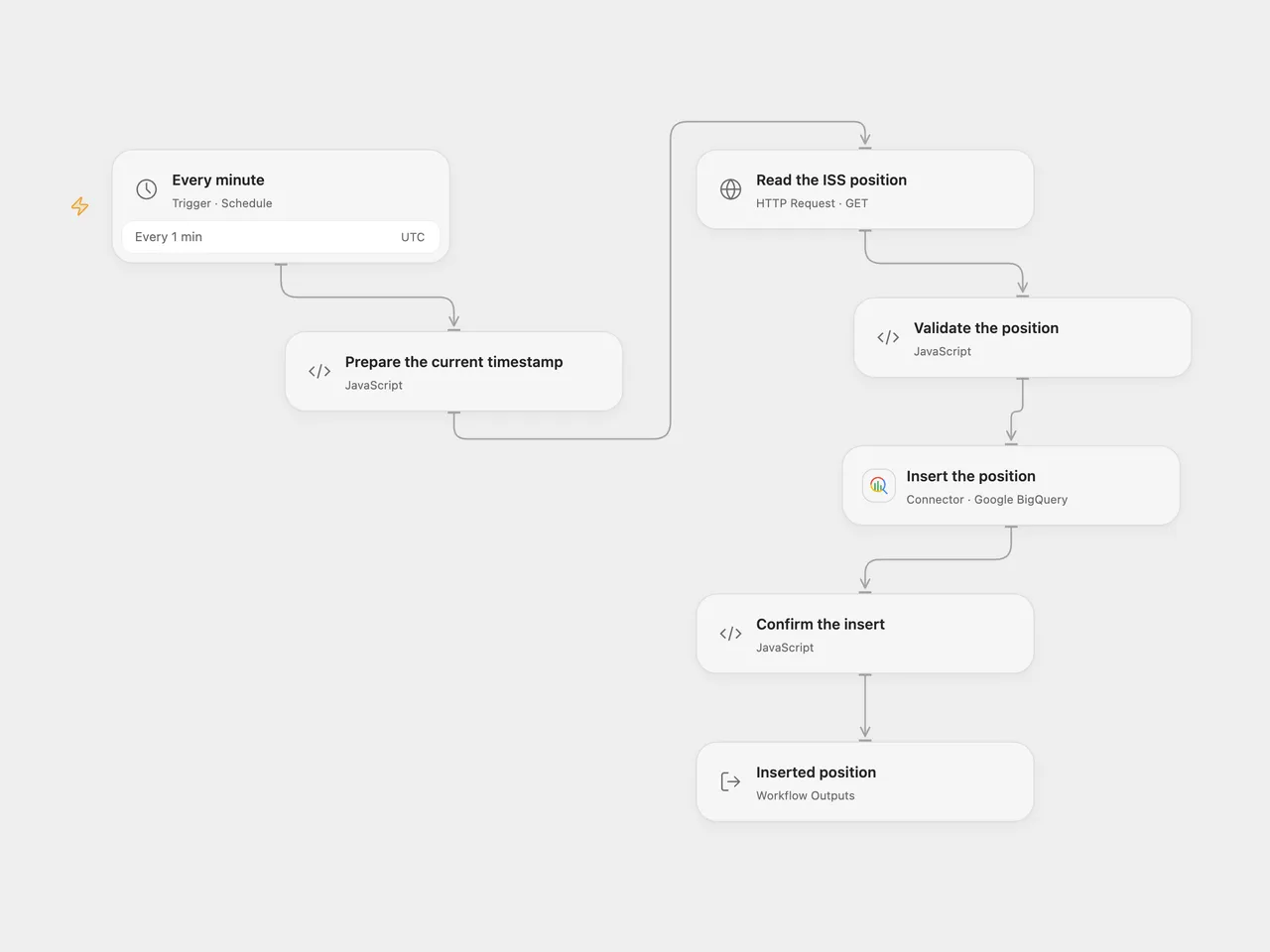
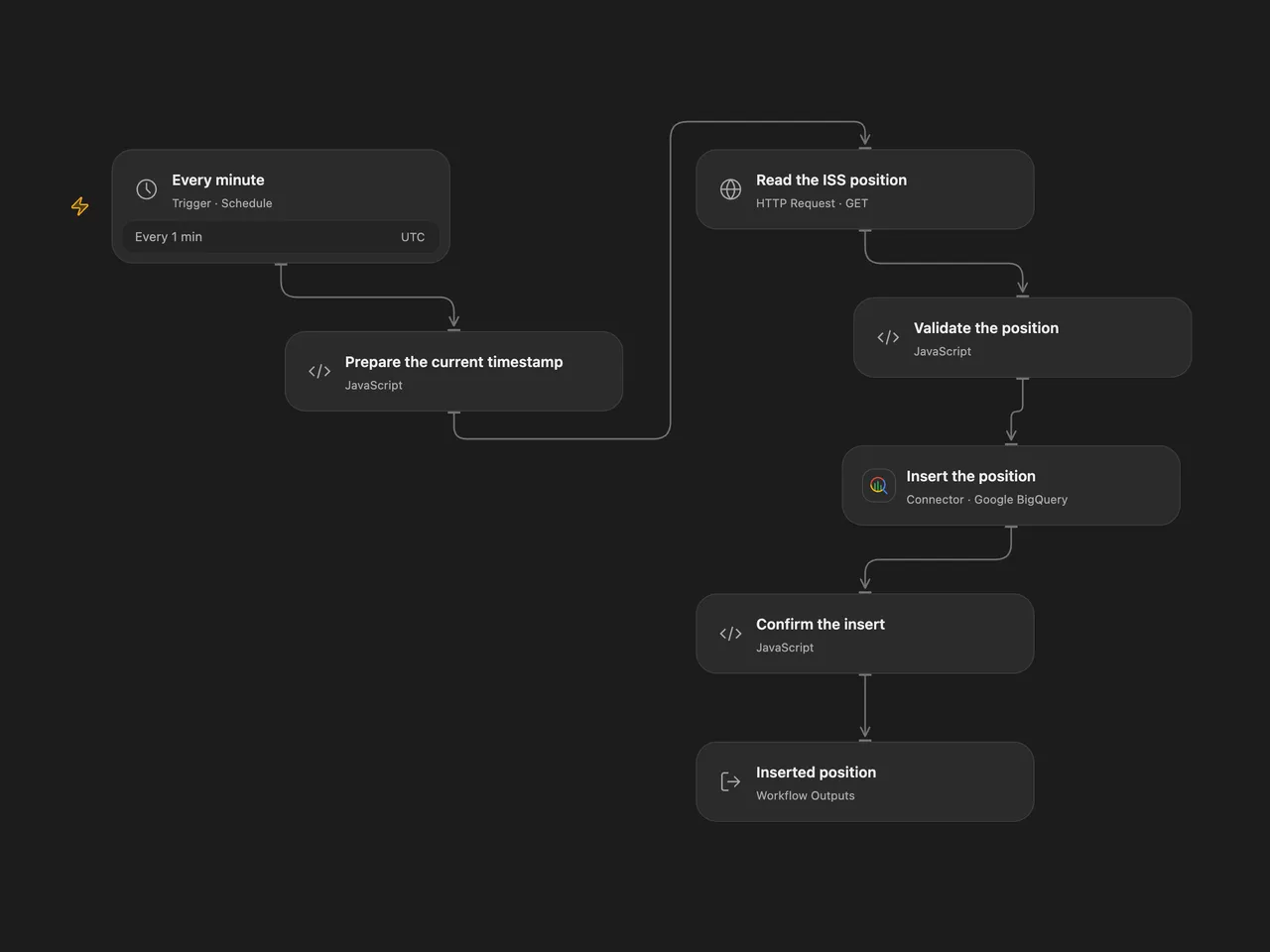
Record the current International Space Station position in a BigQuery table each minute.
Setup
Create a BigQuery table with columns name (STRING), latitude and longitude (FLOAT), and timestamp (INTEGER, Unix seconds). Connect Google BigQuery and set the project, dataset and table IDs on Insert the position. Grant the connection permission to insert rows. In n8n, set the same IDs and connect a Google BigQuery OAuth2 credential on Google BigQuery. Activate one format.
Behavior
Each minute the workflow requests the ISS position for the current Unix second and inserts its name, latitude, longitude and timestamp as one row. A malformed position, HTTP failure, BigQuery error or row-level insert error stops the run. The workflow uses UTC as its schedule starting point; the source inherited the n8n instance timezone. n8n Cron V1 selects a fixed second within the minute; Open Flow uses the minute boundary.
A failed or uncertain insert may have reached BigQuery. Check the table before retrying; the workflow does not assign a deduplication ID or automatically retry. Repeated runs can create duplicate rows. Open Flow does not follow HTTP redirects and applies a 30-second timeout and 4 MiB response limit; n8n uses its HTTP node defaults. The position API is rate limited.
Inspiration & credits
Changes to the source
- Replace private BigQuery identifiers with configuration, and send the current Unix time in seconds instead of milliseconds.
- Validate the returned position and inspect BigQuery row-level errors. Set UTC explicitly.
Adapted from ISS position to BigQuery in Zie619/n8n-workflows. The matching n8n listing credits Harshil Agrawal. The original template does not state a separate license.
The collection’s MIT notice is pinned at a later revision. This is the collection notice at that revision; it does not establish a separate original template author’s license. Our changes are listed above; see repository licensing.
MIT License
Copyright (c) 2025 Zie619
Permission is hereby granted, free of charge, to any person obtaining a copy of this software and associated documentation files (the “Software”), to deal in the Software without restriction, including without limitation the rights to use, copy, modify, merge, publish, distribute, sublicense, and/or sell copies of the Software, and to permit persons to whom the Software is furnished to do so, subject to the following conditions:
The above copyright notice and this permission notice shall be included in all copies or substantial portions of the Software.
THE SOFTWARE IS PROVIDED “AS IS”, WITHOUT WARRANTY OF ANY KIND, EXPRESS OR IMPLIED, INCLUDING BUT NOT LIMITED TO THE WARRANTIES OF MERCHANTABILITY, FITNESS FOR A PARTICULAR PURPOSE AND NONINFRINGEMENT. IN NO EVENT SHALL THE AUTHORS OR COPYRIGHT HOLDERS BE LIABLE FOR ANY CLAIM, DAMAGES OR OTHER LIABILITY, WHETHER IN AN ACTION OF CONTRACT, TORT OR OTHERWISE, ARISING FROM, OUT OF OR IN CONNECTION WITH THE SOFTWARE OR THE USE OR OTHER DEALINGS IN THE SOFTWARE.