內容
OpenAI Text to Speech
Convert supplied text into an MP3 with OpenAI tts-1 and return a downloadable audio file.
下載工作流程
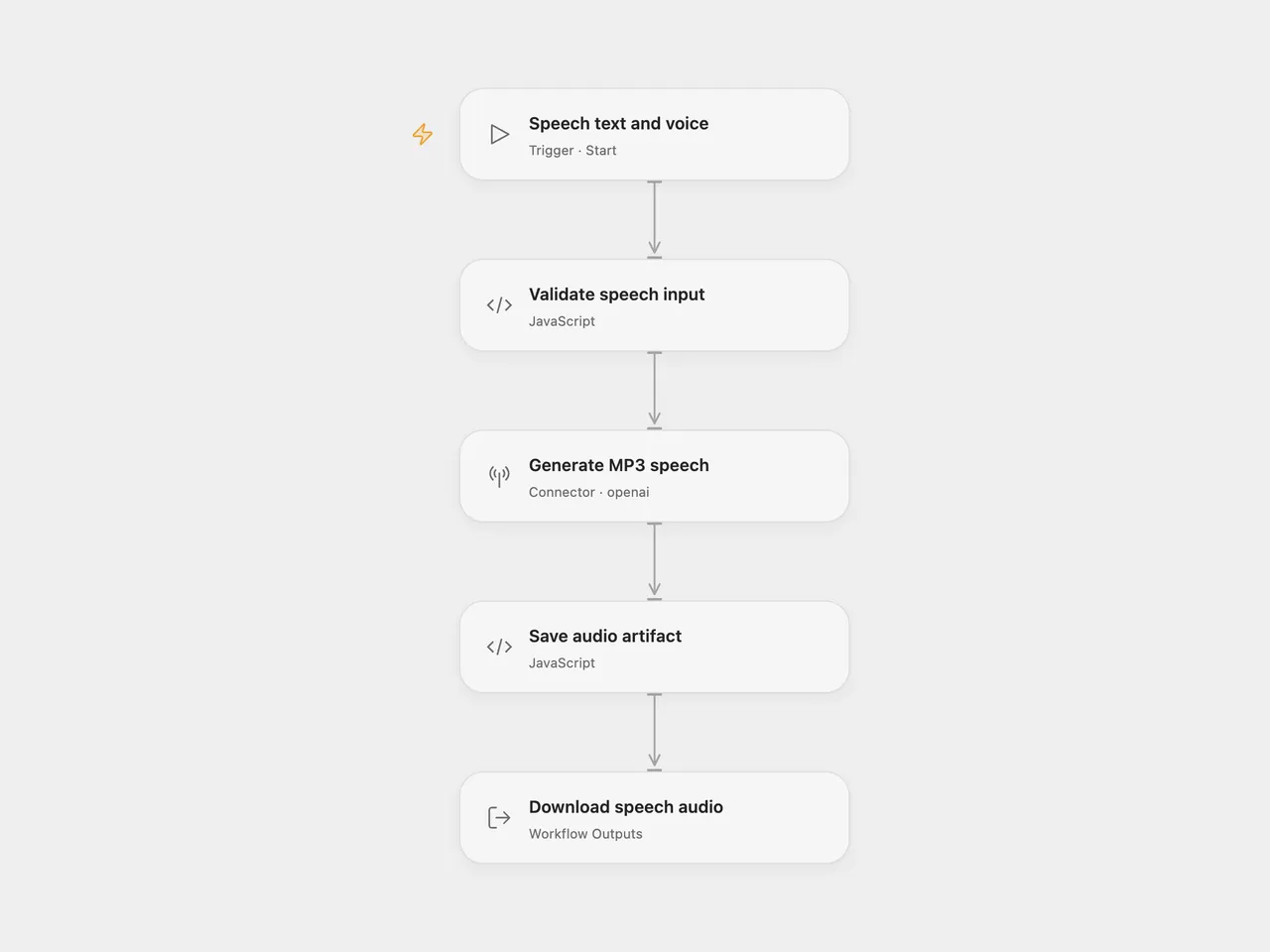
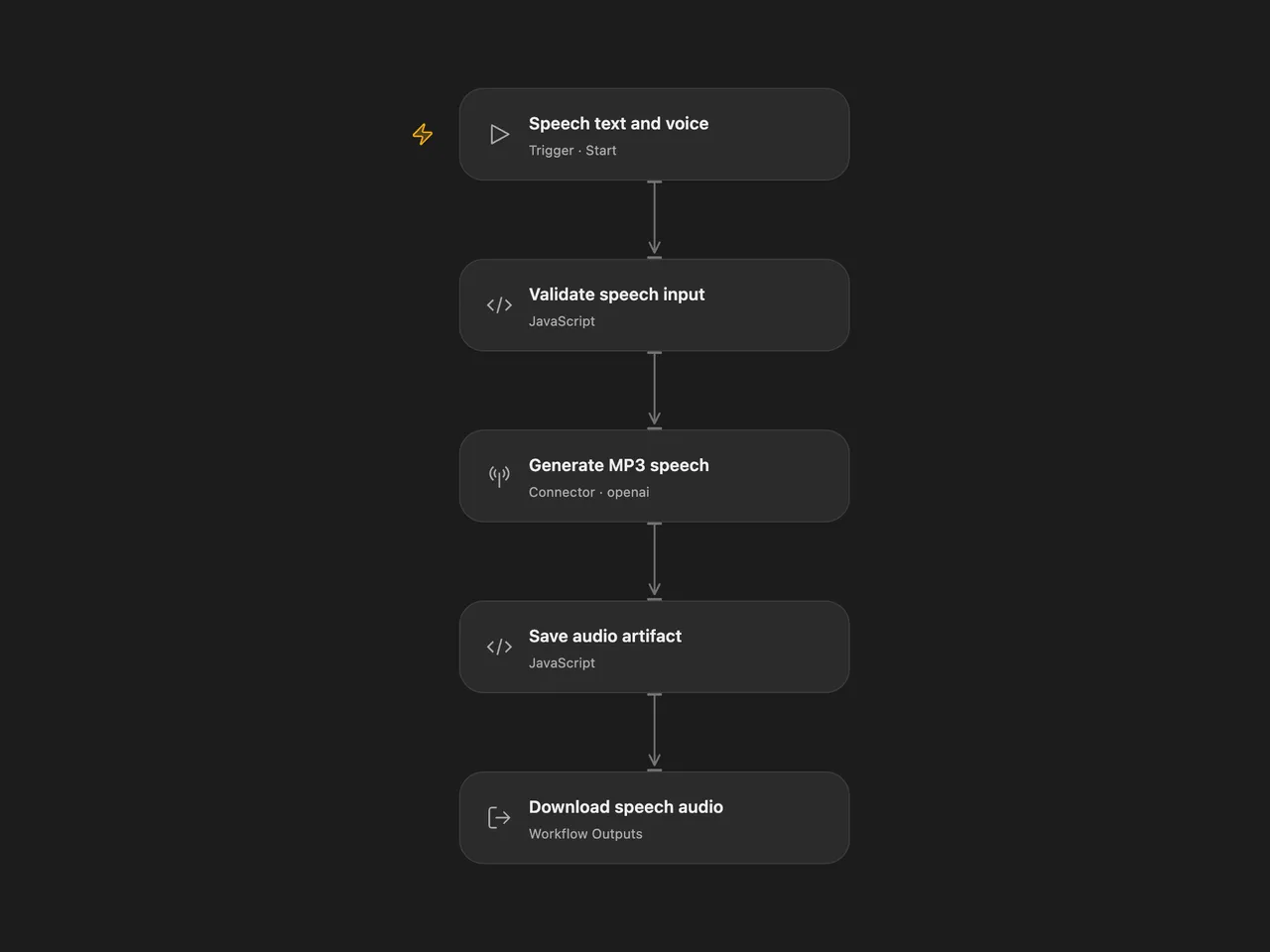
Convert text into an MP3 using OpenAI tts-1. Download speech.mp3 from the Open Flow run result, or use the binary data output in n8n.
Setup and use
Connect OpenAI in Generate MP3 speech. Use Run and supply:
{
  "input_text": "The quick brown fox jumped over the lazy dog.",
  "voice": "alloy"
}
The text must be nonempty and contain at most 4,096 characters. voice defaults to alloy; supported choices are alloy, ash, coral, echo, fable, onyx, nova, sage, and shimmer. Text is sent to OpenAI and generation uses your account’s API allowance.
For n8n, edit Set input text and TTS voice, select an OpenAI credential in Send HTTP Request to OpenAI’s TTS Endpoint, and use Execute Workflow. The request returns an MP3 in binary field data, ready for download or a cloud upload node.
Each run has one synthesis step, with no workflow-level retries configured. The provider manages any internal request retries. A failed request or invalid audio response stops without a successful file result. Open Flow stores the resulting audio as a run artifact. If you share the recording with listeners, disclose that the voice is AI-generated.
OpenAI has announced that tts-1 will shut down on January 6, 2027. This template retains the source model while that endpoint remains available. Plan a migration before that date; the replacement Realtime API requires a different workflow.
Changes to the source
- Remove the redundant literal Authorization header and keep authentication in the account credential.
- Validate text and voice before synthesis, and make MP3 output explicit.
- Correct the source input-limit note to 4,096 characters.
- Preserve binary audio as a downloadable Open Flow artifact or n8n binary output.
Adapted from Convert text to speech with OpenAI in enescingoz/awesome-n8n-templates.
Source collection notice: © 2024–2026 Enes Cingoz, CC BY 4.0. The source export does not identify a separate template author or license. See repository licensing for the scope of OOMOL contributions and third-party material.