On this page
If you’re evaluating Open Flow alongside Zapier (https://zapier.com/), the core difference is architectural depth. Zapier was designed around linear cloud triggers and locks advanced routing, webhooks, and enterprise control behind rigid tiers. Open Flow is built for AI-native orchestration, agent-assisted authoring, full data sovereignty through self-hosting, and unified service access.
App integrations and tools
Both platforms connect to common SaaS tools like Gmail, Slack, Notion, HubSpot, and Google Sheets—but how they handle AI services, custom APIs, and connector governance is fundamentally different.
| App connections | Open Flow | Zapier |
|---|---|---|
| Built-in integrations | 1,700+ apps and services, 20,000+ ready-to-use tools | SaaS integrations only; premium apps and webhooks are locked behind higher tiers |
| Community & maintenance | OpenConnector is community-contributed and maintained by the official team | Custom apps require building and maintaining separate wrappers via Zapier’s developer CLI |
| Paid AI & data services | One OOMOL account for multiple paid AI and data services, with no separate provider signups | Acts only as a pass-through; you still manage separate provider accounts and API keys |
| Service billing | Pay for what you use, unified in one account | Separate subscriptions and bills for every third-party AI or data provider |
| Custom APIs & schemas | Native HTTP Request and OpenAPI nodes for calling any REST or OpenAPI service | Webhooks are gated to paid plans only, with no native OpenAPI schema node |
In Open Flow, you can combine SaaS connectors, OpenAPI endpoints, and paid AI services under one account—without managing scattered API keys or upgrading plans just to make an HTTP call.
Browse Open Flow’s apps and toolsBuilding and editing workflows
Open Flow is engineered for complex multi-step logic, structured AI decisions, and programmatic editing by coding agents. Zapier’s builder remains centered on linear cloud rules with limited developer tooling.
| Building and editing | Open Flow | Zapier |
|---|---|---|
| Typed I/O | Typed inputs and outputs for static checks, testing, and direct agent inspection without wasting tokens on sample payloads | Untyped dynamic fields; requires running live trigger/action tests first to surface sample keys for mapping |
| Flow control | Unlimited steps, conditional branches, loops, sub-workflows, and human-in-the-loop approvals | Linear trigger-action model at its core; Paths and Filters are gated, with no native pause-for-approval node |
| AI tasks | LLM and Agent nodes, plus JEV decision nodes to classify, assess, and score input in one call | Basic AI steps only, with model multipliers that consume extra tasks per run |
| Triggers & webhooks | Webhooks, cron schedules, and polling built into the core engine | Relies on 15-minute polling on entry tiers; webhooks are only available on paid plans |
| CLI & MCP authoring | Designed for agent editing, with node inspection, targeted edits, atomic updates, and conflict checks | Zapier CLI is only for building custom app wrappers; Zapier MCP only exposes hosted tool calls, not workflow editing |
| Version control | Built-in revision history, published versions, and rollback | Limited version history; no local Git-friendly workflow files |
For example, an AI Decision node can classify a support email and assess its urgency in a single call, then route it through a Condition node or pause for human review. Because every node defines typed inputs and outputs, wiring errors are caught statically and workflows are easy to test. With Open Flow’s CLI and MCP tools, your coding agent can read node schemas and edit the workflow graph directly without running live steps first to guess field keys.
Example workflow: email classification and logging
Here is a practical workflow for triaging incoming emails:
- Read new unread emails from Gmail.
- Classify each email with AI and generate a one-line summary.
- Append the date, sender, subject, category, and summary to Google Sheets.
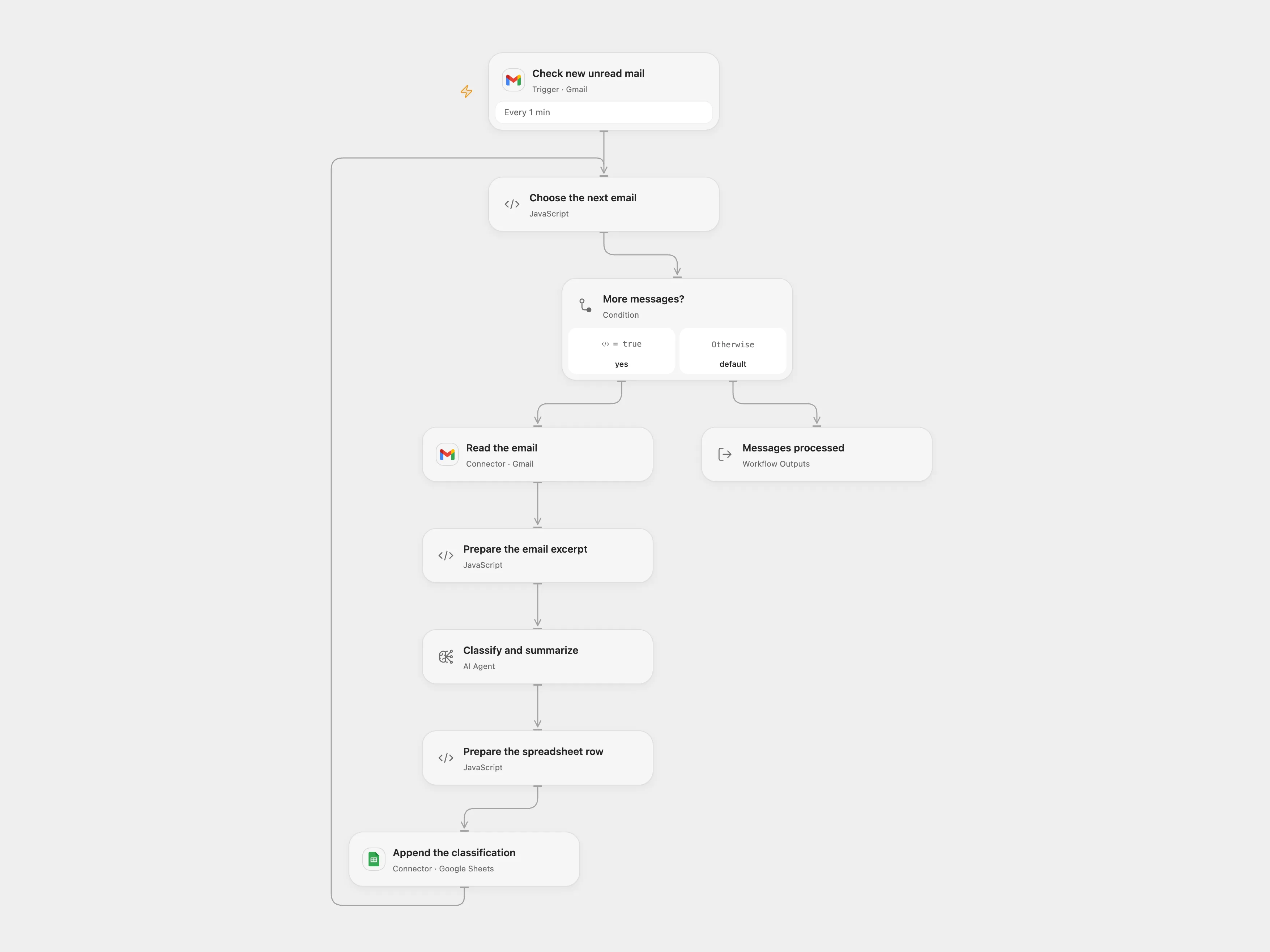
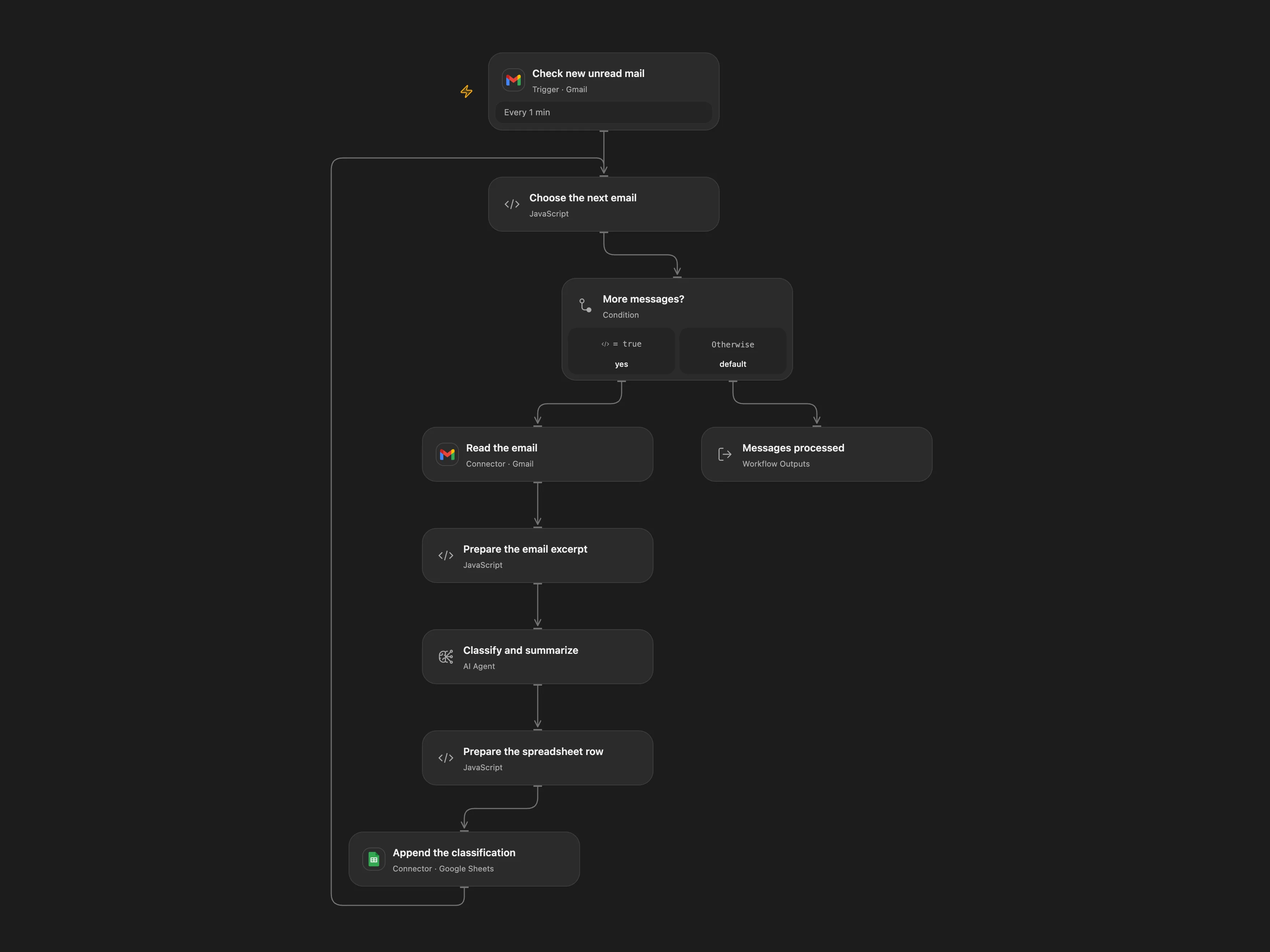
The email classification workflow in Open Flow, built with structured nodes, revision history, and agent-editable JSON.
In Open Flow, this workflow is represented as an open, inspectable graph with built-in versioning. You can import it, connect Gmail and Google Sheets, swap in your preferred LLM endpoint, or ask your agent to extend it with Slack escalation and approval steps.
View template files and setup instructionsSelf-hosting and data control
For teams with strict data governance, latency, or compliance requirements, the deployment model is a decisive boundary.
| Self-hosting | Open Flow | Zapier |
|---|---|---|
| Deployment | Open-source and self-hostable with Docker on your own infrastructure | Closed-source SaaS only; no self-hosting option at all |
| Custom LLMs | Set your own model endpoint and API key, including local and OpenAI-compatible models | Cloud-only integrations; no self-hosted local model runtime |
| Workflow portability | Standard open workflow files you can version in Git and move freely | Locked inside Zapier’s proprietary cloud format |
| Official integration services | Self-hosted instances can still use OOMOL’s hosted services, billed by usage | Not applicable—all execution must stay on Zapier’s servers |
Zapier only runs in Zapier’s cloud, meaning your workflow logic, payloads, and execution logs never leave their servers. Open Flow lets you deploy on your own servers whenever needed—while still letting you tap into OOMOL’s hosted connectors if you don’t want to maintain OAuth apps yourself.
Cloud hosting and pricing
Open Flow gives you full workflow capabilities on every tier and scales with predictable usage. Zapier gates core features and charges steep task-based tiers.
| Cloud hosting | Open Flow | Zapier |
|---|---|---|
| Free option | Free plan with monthly allowances, including multi-step flows, branching, AI, and webhooks | Only 100 tasks/month, two-step Zaps only, 15-minute polling, no webhooks |
| Entry-level monthly price | $15.90/month | $29.99/month billed monthly ($19.99/month billed annually) for only 750 tasks |
| Billing & overage | Monthly allowances, then pay for actual usage—no forced tier jumps | Task-based tiers where AI steps can burn multiple tasks per run, with automatic overage fees |
Open Flow separates capability from pricing. You don’t have to pay $29.99/month just to unlock multi-step routing or webhooks, and you won’t hit task-multiplier surprises as your AI workflows grow—just predictable, usage-based scaling.