AI Decision
Evaluate named questions with a model and return structured assessments for explicit downstream rules.
Use AI Decision to evaluate a business question whose answer needs model judgment. Use Condition when the rule can be expressed as an ordinary comparison.
Questions
Configure a unique name and instructions for each question. The supported question forms are a Boolean-style assessment, a choice among named criteria, and a score over ordered criteria.
{
  "op": "node.add", "as": "classify", "type": "decision", "name": "Assess urgency",
  "config": {
    "questions": [{ "name": "urgent", "type": "noul", "instructions": "Does the ticket describe a service outage?" }]
  },
  "inputs": { "target": { "kind": "value", "value": "Every checkout payment is failing." } }
}
The target input accepts the supported text, object, or array data to evaluate. Criteria describe the meaning of the result. Read the current question schema for allowed fields and bounds.
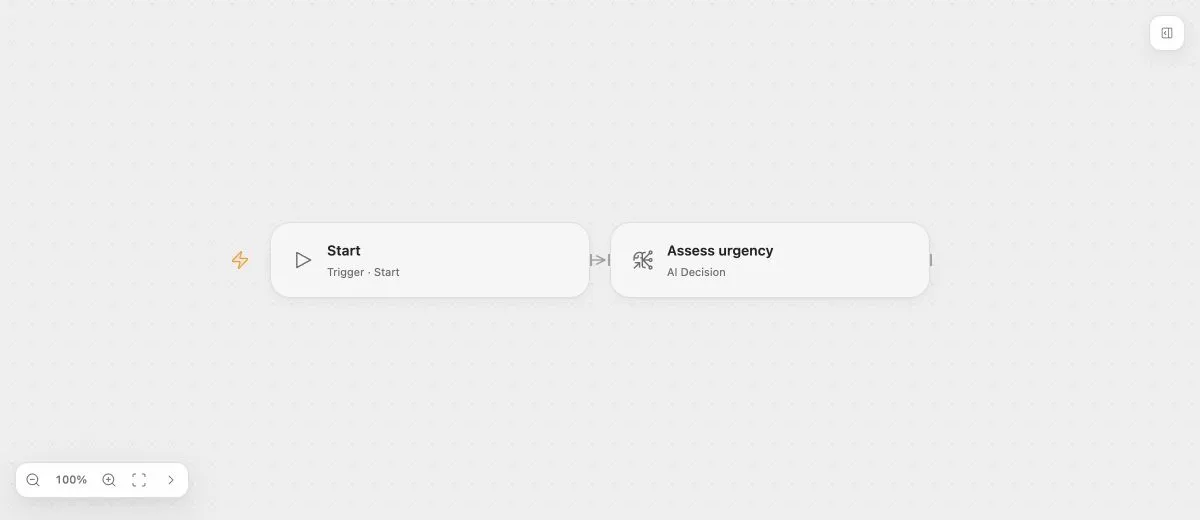
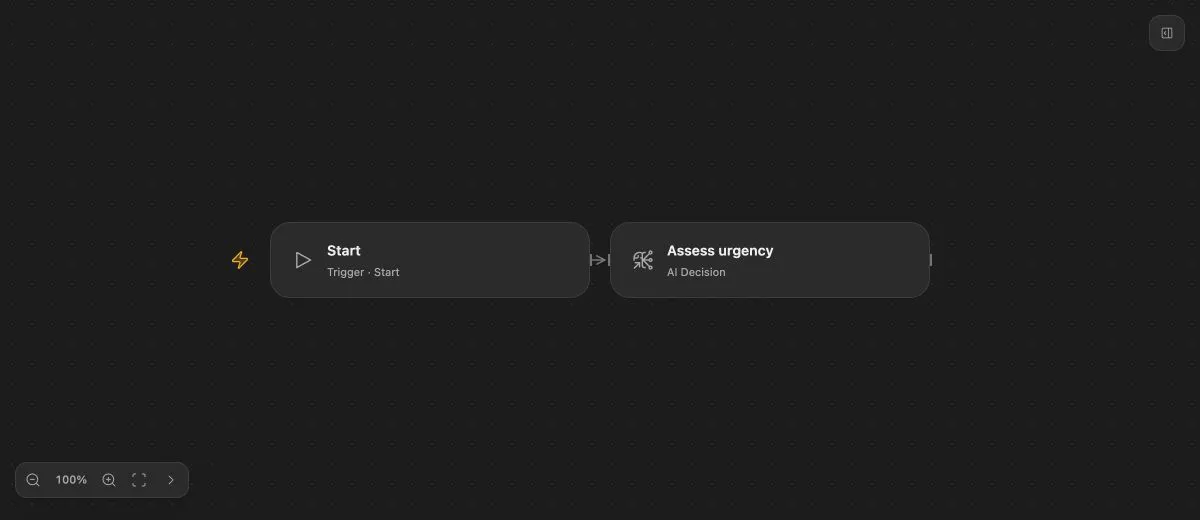
- Input
- A ticket reports that every checkout payment is failing.
- Expected result
- The urgent output contains the model assessment. Use Condition to route on that output.
- Before running
- The deployment must support the AI Decision model service. Assessments are model-generated.
Outputs and routing
Each question creates a named structured output. The Boolean-style noul question returns an object containing its type and a numeric assessment between 0 and 1. It is not a Boolean branch handle.
Connect a Condition node and bind the relevant assessment field when you want to route execution. Choose a threshold appropriate to the task rather than assuming that a model assessment is certain.
Deployment and failures
AI Decision uses the deployment’s supported decision model service. The preview displays the question and port definitions without calling a model or evaluating the sample.
The Task supports retries and handled errors. These settings affect failures of the Task, not the correctness of a successfully generated business judgment.