HTTP Request
Call an HTTP endpoint without an OpenAPI document or Connector Action.
Use HTTP Request for a single HTTP(S) call. The node owns generated ports, parameter encoding, and response parsing.
Configure the request
Business configuration selects method, query/header modes, authentication, body format, response format, and status policy. URL and request values belong in inputs, including fixed values.
{
  "op": "node.add", "as": "request", "type": "http-request", "name": "Read service status",
  "config": { "method": "GET", "responseFormat": "json", "statusPolicy": "success" },
  "inputs": { "url": { "kind": "value", "value": "https://api.example.com/status" } }
}
Replace the example endpoint before running. For named query or header fields, configure the group’s names and bind query.NAME or header.NAME. Whole-object mode uses query or headers instead.
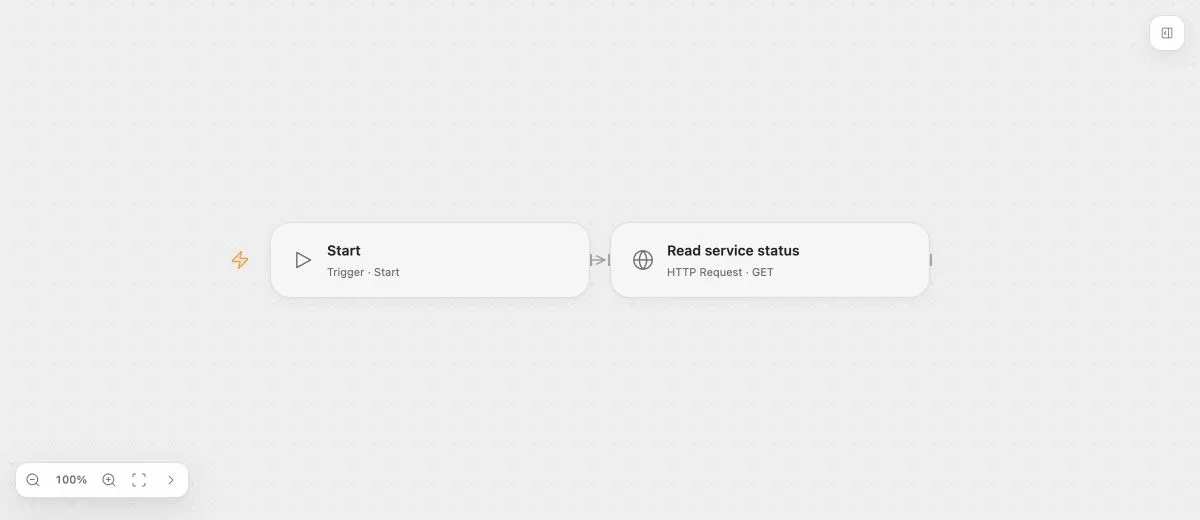
- Input
- GET https://api.example.com/status
- Expected result
- For a successful JSON endpoint, body contains its decoded response and statusCode contains its HTTP status.
- Before running
- Replace the example URL with your endpoint and configure authentication if required.
Authentication
Authentication supports the advertised choices such as bearer, Basic, or API key. Credential fields accept Variables or upstream outputs rather than fixed literal credentials. Bearer uses auth.token; Basic uses auth.username and auth.password.
Authentication is replaced as a whole choice. Changing parameter modes removes bindings for removed ports while preserving configured names according to the edit contract.
Results
Outputs are always body, statusCode, and headers. A JSON array remains one body value. Choose automatic, JSON, or text response parsing according to the endpoint.
The default success policy treats non-2xx status as failure. Use statusPolicy: "all" when downstream Condition logic should inspect a non-success response. Network and parsing failures still fail.
Failure handling
HTTP Request supports ordinary retries and onError handling. There is no separate error execution edge. Retrying a write can repeat its remote effect; choose that policy with the endpoint’s behavior in mind.