JavaScript
Transform inputs with an isolated JavaScript module and explicitly declared outputs.
Use the JavaScript node for transformations, calculations, or combining supported capability calls. For a single HTTP request without transformation, HTTP Request usually needs less configuration.
Module and ports
Code is an ES module whose default export receives (inputs, context) and returns business outputs, or a Promise of those outputs.
export default ({ name, prefix }) => ({
  message: `${prefix}, ${name}!`
});
Declare custom output schemas through config.outputs. Bind named inputs directly, with optional constraints in config.inputs. The public interface owns module identities and runtime assembly.
{
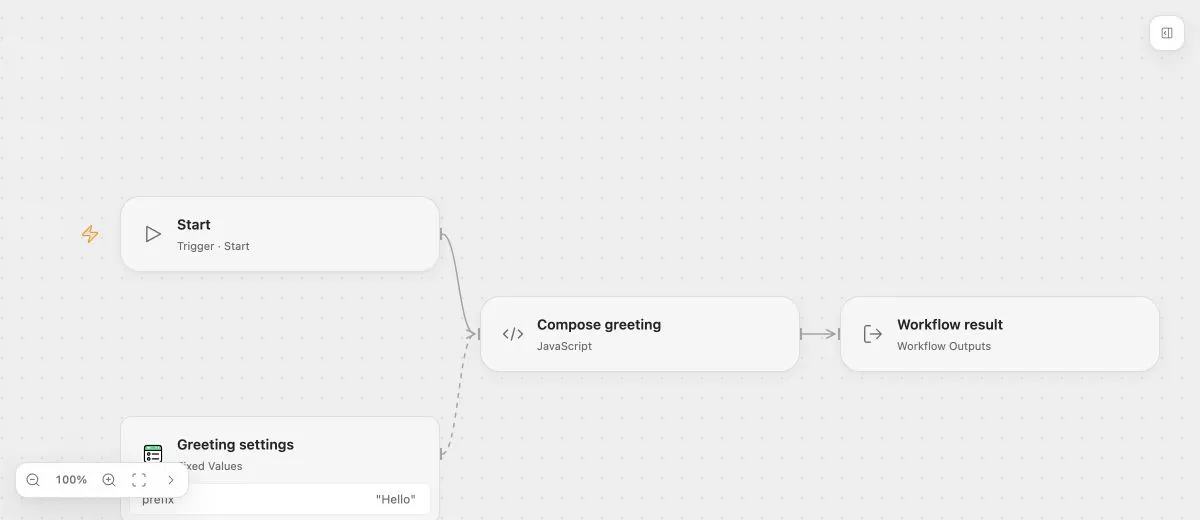
  "op": "node.add", "as": "greet", "type": "code", "name": "Compose greeting",
  "code": "export default ({name, prefix}) => ({message: `${prefix}, ${name}!`});",
  "config": { "outputs": { "message": { "schema": { "type": "string" }, "nullable": false } } },
  "inputs": {
    "name": { "kind": "value", "value": "Ada" },
    "prefix": { "kind": "value", "value": "Hello" }
  }
}
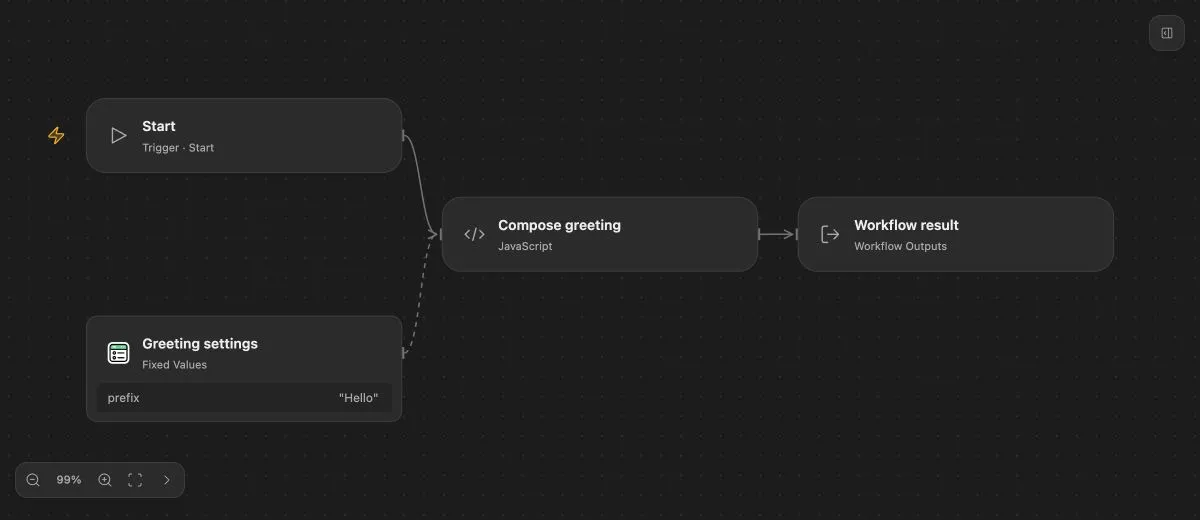
- Input
- {"name":"Ada"}
- Expected result
- {"message":"Hello, Ada!"}
- Before running
- An Open Flow deployment is needed to execute or import this example. The preview itself runs offline.
Runtime boundaries
The supported Node built-ins form a compatibility subset. A fresh in-memory filesystem starts at /tmp for each Task. It does not expose the host disk or persist into the next invocation. Arbitrary packages, dynamic imports, and CommonJS require are unavailable.
Use explicit Code capabilities for Connector Actions, workflow calls, and HTTP hosts. context.fetch is bounded by the declared hosts and the deployment’s current Engine Contract. It does not inherit platform credentials or grant unrestricted networking.
Persistent results and failures
Return JSON business outputs. Use the supported Artifact interface for Run-owned bytes, and explicit Flow State for cross-Run business values. Virtual files and local globals are not durable stores.
Code supports Task retries and handled errors. A retry repeats the whole module and can repeat external operations. Resource limits, cancellation, and unknown outcomes retain their runtime boundaries.