Fixed Values
Store named JSON constants that other nodes can bind as inputs.
Use Fixed Values for reusable settings and business constants: labels, thresholds, object templates, or small reference data that belong in the workflow definition.
Configure values
{
  "op": "node.add", "as": "settings", "type": "value", "name": "Greeting settings",
  "config": {
    "values": { "prefix": "Hello", "limit": 10 },
    "outputs": {
      "prefix": { "schema": { "type": "string" }, "nullable": false },
      "limit": { "schema": { "type": "number" }, "nullable": false }
    }
  }
}
Values are JSON. Declare constraints when downstream consumers require a stable type or need to select an object property. A single sample value is not a reliable permanent business schema.
Bind outputs
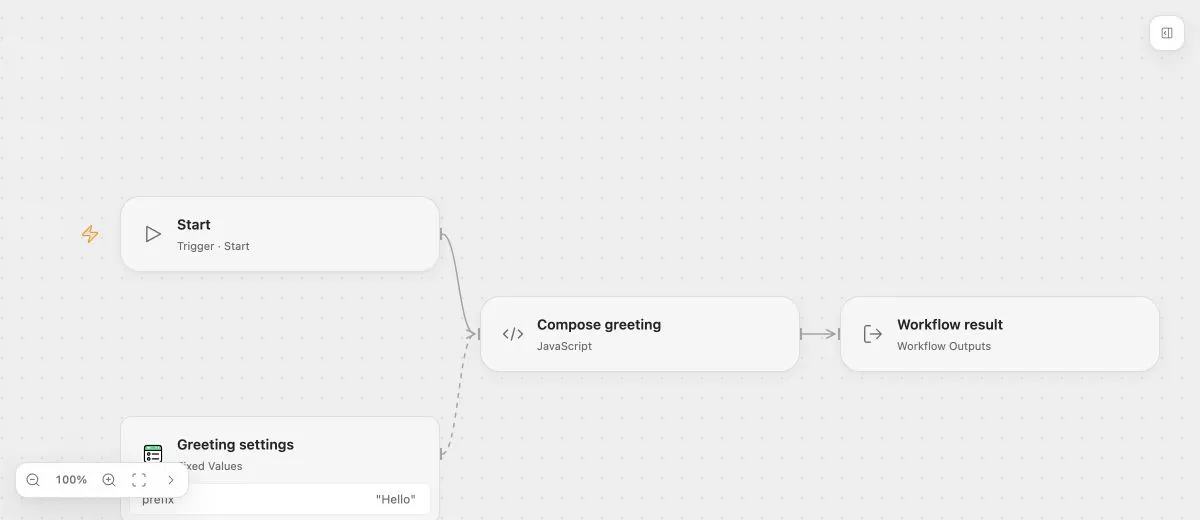
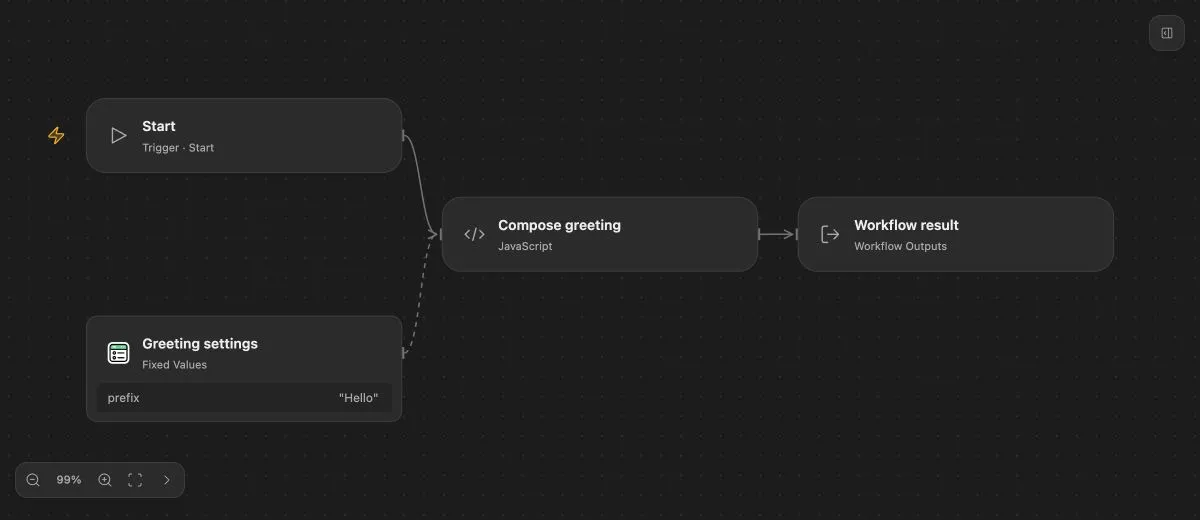
Each named value is a business output. Downstream nodes bind the desired name separately from their execution edges.
- Input
- {"name":"Ada"}
- Expected result
- {"message":"Hello, Ada!"}
- Before running
- An Open Flow deployment is needed to execute or import this example. The preview itself runs offline.
The example’s prefix is available to Code on its selected execution path. Changing the Value changes the Draft definition; existing accepted Runs retain their fixed configuration.
Choosing a storage location
Use a fixed node input for a value used only by that node. Use Value for shared constants that belong in the Flow. Use Variables for account-owned configuration, and explicit Flow State for cross-Run business state.
A Value node does not provide a secret store or external authorization. It has no ordinary Task retry policy or error-handling configuration.